

Two Spirit and I
Words and Graphics by Tobias Soudaly-Espinosa with contributions from Kevin Abourezk
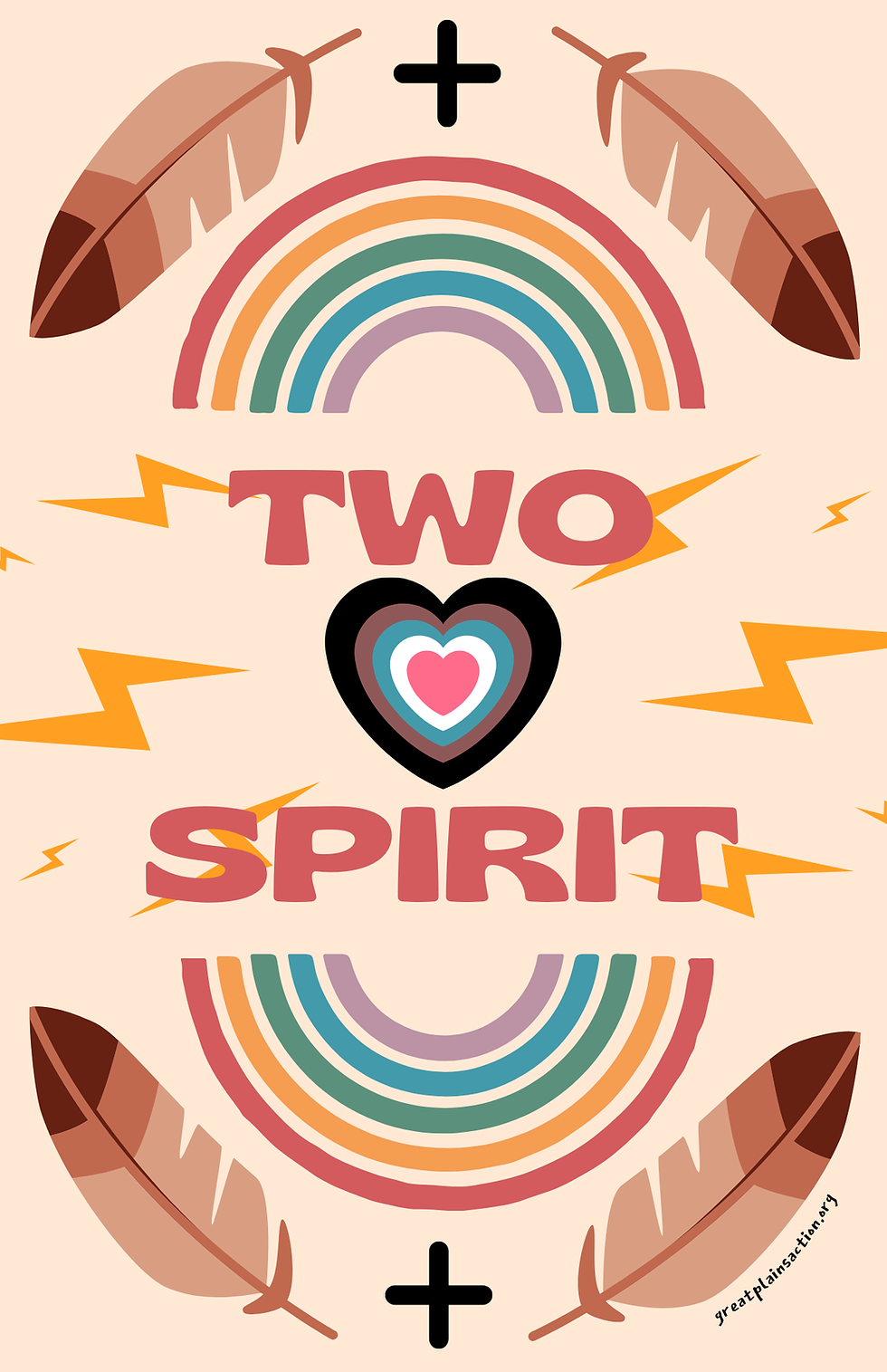
Poster by Sikowis Nobiss

(Disclaimer: I use the term “queer” as a way to refer to all non-cisgender and non-heterosexual identities. Additionally, all modern terms we are using to describe Two-Spirits are not 1-to-1 equivalents and are simply the closest approximate translations.)
Every pride month, I remember how I came to accept myself as I am. I was already slow to explore sexuality, and it took me a while to accept myself as Bisexual. It took even longer for me to confront my gender.
I didn’t let myself experiment with gender until COVID. I had a good number of trans friends by this time, and I was much more comfortable with the concept of other folks being trans before I was comfortable with the idea that I could be trans. By that point, I had grown into a very feminine body that had a natural strength – enough to be the “man” at my grandmothers’ houses. I opened their pickle jars, moved giant plant pots for them, carried their groceries and their furniture and got their window ACs from the basement. I had moments where being a girl and feminine, and being perceived as “girly,” brought me immense joy. I loved how beautiful I was, and how much I looked like the closest women in my life. I had other moments where being seen as a girl and a woman sat wrong in my heart. Where I wanted my body to look like my brother’s or my dad’s. I even wished I could somehow switch genitalia – sometimes out of curiosity, sometimes out of a sense that that would be more “right” – but I assumed that was weird and wrong because I was “obviously” a girl and (sometimes) liked being one. When I started playing with gender, I was 18 and knew “trans” was close to how I felt, but it wasn’t quite right. I started switching pronouns every day just to see which one felt more right and I learned that they all felt right on different days.
I had a best friend in middle school. She’s not genderfluid now, but she was when I met her, and she introduced me to the idea of genderfluidity. I remembered how it made me feel. It knocked on some dormant part of me I wasn’t ready to explore yet, but it stuck with me. At 13, I couldn’t process why it stuck with me so much, but at 18 I was hit suddenly with how right genderfluidity felt in my body, and accepting that I was genderfluid made my cognitive dissonance around my gender make sense for the first time.
My gender and sexuality expression were not taught to me. My friends and I simply heard through the grapevine about these concepts and identities that could have been ours and we were able to learn ourselves from each other. While I had found myself surrounded by people like me at school, I remember the wonder when I learned about Pride Month and the idea that so many people like me would all be in one place together and how amazing it felt to realize how accepting my environment was in reality. I learned about many different terms and labels from hours on Wikipedia and “am i gay?” Buzzfeed quizzes. Lesbian, queer, genderqueer, sapphic, non-binary, intersex, Achillean, agender, aromantic, demisexual, asexual, polyamorous, bi-gender, etc. It was also here that I learned about Two-Spirit.
Two-Spirit, in 2020 was VERY new to me and hard to research. While I very much identify as Native, I often feel as though I’m not Native enough to claim labels like Two-Spirit, and at the time the definitions I could find were vague at best. Modern terms in English describing gender and sexuality are based on rigid western gender norms even as they exist outside those norms. Thus, many of these labels are rigid, clearly defined categories, even if queer people in real life understand that gender and sexuality are more nuanced than that. Two-Spirit is inherently a fluid term for many reasons: First, this is an incredibly new blanket term, first documented in 1990, to describe all the ways and traditions around being not cis- and not straight in ALL indigenous North American tribes; Second, not only did every tribe have its own traditions and understandings around being queer, but even clans within tribes can (and often do) have differences in their understandings; Finally, it is largely understood in many traditions that gender exists on a spectrum, which is becoming widely accepted in modern trans-inclusive spaces. Naturally, I was drawn to the fluidity of the term, and even the little I knew resonated so much with my new understanding of myself. I held back from claiming it, however, because there’s a LOT of stigma around Two-Spirit folks in Indigenous communities.
My colleague, Kevin Abourezk, and I called some of our Elders and mentors to help us better understand what Two-Spirit actually means traditionally. The consensus that seems to exist online describes Two Spirit as a person “having both the spirit of a man and a woman” and I like that generalization, but it's specifically derived from an Anishinaabe understanding. The term "Two-Spirit" is a very literal translation of an Anishinaabe phrase. As I was raised Dakota, I have now been taught a different version of it.
Dakota people have this word “Wiηkte,” and it has 2 translations. Its main interpretations are either “killed by a woman” or “future woman.” In the first interpretation,“Wiη” literally translates to “woman” and “Kte” can be translated to “be killed” or notes a future tense. It refers to a queer man whose heart has been “killed by a woman,” essentially referring to a person who was born a man but has taken on female characteristics and feelings.
The second interpretation of “Wiηkte” breaks down as “wiη” for woman and “kte” as denoting something happening in the future. So in that interpretation, the word can be understood to mean a “future woman.” Many Indigenous people believe in reincarnation and in something a mentor referred to as “transitionary lives” in which our souls are preparing themselves for a future life. So in this context, a wiηkte might be a man whose soul is preparing itself to be a woman in their next life. Our elders and mentors were not able to give us an equivalent phrase to describe the female-to-male experience. Wiηkte used to be used almost as a slur after the boarding school era, and I suspect that its use as a slur against men who aren't perfectly "masculine" or macho is the biggest reason we still have it.
As Kevin and I spoke to our mentors and elders, it quickly became very clear that not only do we lack a lot of information about Two-Spirits across turtle island but that lack of information was DIRECTLY caused by current and historical stigma against Two-Spirits both within native and non-native communities.
I mentioned that Two-Spirit is a new term. My elder told me that it comes from the boarding school era. In his context, we didn’t need a unified term to describe non-cis-hetero folks until boarding schools forced Christianity and oppressive gender norms on all of their kidnapped students (read more on what boarding schools took from us in "Missing and Murdered"). Kids were forcibly assimilated in such cruel ways, even those who survived and happened to hold onto their languages would refuse to speak them decades after graduating. Through boarding schools, in addition to all the other traditions we lost, being queer was taught to be inherently bad and patriarchal gender norms replaced our teachings. In the US, it continued to be unsafe to be openly queer for so long, people were forced to either hide their queerness or shun it from others until many folks internalized this oppression in themselves. At the time of writing, there are MANY reservations and tribes that rigidly adhere to post-Christianized gender norms, to the point where some places don’t allow female- and feminine-bodied folks to be healers, or drummers, or singers, or warriors as we once were.
So many of us have forgotten that in traditional Indigenous cultures, genderfluidity was far more accepted. Perhaps it was the product of living in harmony with nature, which also finds expression in genderfluidity, and perhaps it is the simple fact that when you watch a child grow up and know them from the time they were born you realize that some people are simply born different and that sexual orientation is not a choice. We fear what we do not know, and Indigenous people once knew each other well.
A friend who became a teacher said she grew up believing that sexual orientation was a choice but after spending many years teaching third-graders, she came to understand that some children are born different. Some little boys grow up wanting to be little girls and expressing themselves in feminine ways, and some little girls grow up wanting to be boys without any adults in their lives to set that example. This realization finally helped her understand that sexual orientation is not a choice. Today, because of how narrow our definition of family and community has become, too many of us don’t ever become acquainted with queer people until we meet an adult queer person. Not knowing many queer children, it becomes easier to assume being a queer adult was a choice that person made rather than a fact of who they were from the inside out. And many queer children – having grown up in a society in which genderfluidity often isn’t accepted – also mask their queer characteristics until they become adults and through years of personal discovery become who they have always been.
One of my mentors told me the story of how she wasn’t able to claim being Two-Spirit for decades. Cancel culture is older than you think. In the ’90s, she had been using the term Two-Spirit for some time until she was shamed out of it by other Two-Spirit folks, because they assumed that you had to be a trans man or trans woman to claim the label. To be fair, that is one of the many understandings of what it means to be Two-Spirit. My Dakota elders explained to me that Two-Spirit and Wiηkte originally referred to the way people moved through community, acting in opposite gender roles than were the norm, finding community more easily with one of the binary genders than their own, and combinations thereof, very similar to our modern understanding of “Gender Expression”. They told me that though they knew Two-Spirit folks growing up, they didn’t know them in relationships, so it’s new for a lot of Elders and older folks to see this shift in Two-Spirit now describing romantic and sexual relationships. My mentor is able to reclaim the term now that she has learned better, but she’s still looking for a better term in her traditions and language to describe herself.
The mentors and elders we spoke with all lamented how much we’ve lost. We have very few stories left with Two-Spirit identities in them. Two-Spirit elders already are few and far between. I feel incredibly lucky to have the elders I do, and to have learned all that I have from them. I really resonated with a phrase one of our Dakota mentors gave us, “strength of a man, heart of a woman” and I’ve never had anything that fits me so perfectly before. I have been so lucky to be able to claim being Two-Spirit freely and explore what that means for me.
This Pride Month, I want to share this freedom to know yourself. Two-Spirit folks are STILL here even after boarding schools tried to erase this part of us. We might never have the same understandings that we did pre-colonial contact, but I am still here and still able to claim my identity because I am surrounded by a supportive community and am free to be who I am from the inside out. If you are queer or Two-Spirit and native, I urge you to offer your elders that you trust tobacco for their stories and information, or who they might know that you could ask. For everyone this Pride month, I ask that you approach new and old ideas about being Two-Spirit or other forms of gender and sexual identity with an open heart. How else can we carry forth this history and our freedom to be who we’re allowed to be?
Our 4 elders’ and mentors’ names have been omitted for privacy.
What makes basketball stars stand out is how unpredictable live matches can become. A comfortable lead can disappear within seconds when a skilled opponent starts making accurate shots, keeping both players focused until the final moment.
It reminds me of a Doodle Baseball community event I attended where traditional stories were shared. It truly fosters understanding and connection. Keep spreading awareness!
Homeowners researching kitchen reno Toronto often compare cabinet materials based on durability, appearance, maintenance, and overall project budget.
What a powerful, heartfelt read! Your personal self‑discovery paired with Indigenous elder perspectives on Two‑Spirit and Wiηkte feels so honest and eye‑opening. It’s critical to highlight how colonial boarding schools harmed traditional gender teachings. Thank you for putting this important piece out into the world. --wordcam
Thank you. Ordu Havaş saatleri, havalimanı servis güzergâhları, I got a better idea about its features and overall kalkış noktaları ve güncel ulaşım bilgilerini Excelente análisis sobre la evolución de la United Cup; me gustó la evaluación ededderf